
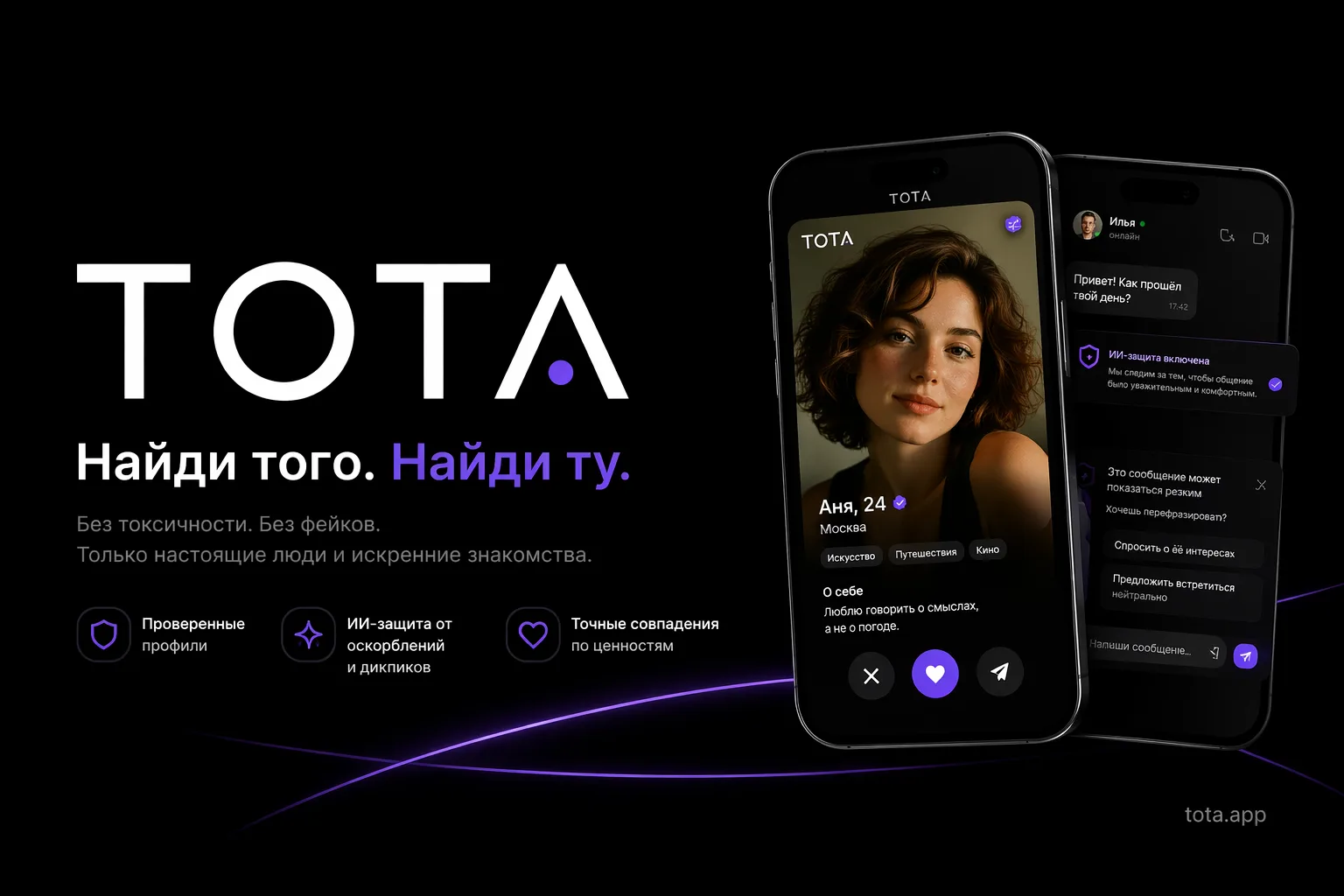
The problem: plenty of matches, no conversations
In dating apps, matches are easy and conversations die fast. Someone has twenty open chats, half of them never got past “hi”, and a week later it’s a graveyard of dialogues. The other common complaint is fake profiles.
TOTA is built around that problem. You can still browse profiles, but the product is designed so that a conversation, once started, keeps going, and there is a real person on the other side.
Chat seasons
Every conversation has a season, and the chat background changes with it:
- Spring: the conversation has just started.
- Summer: after the first ten messages the conversation counts as warmed up.
- Autumn: the conversation went quiet, either spring with no reply for six hours or summer with no messages for twelve hours.
- Winter: autumn has lasted a day. A warning arrives a couple of hours before winter, and new messages bring the chat back.
The season is computed on the server, on every message and by a background worker every half hour. The client receives it with the rest of the chat state over SignalR. It isn’t gamification for its own sake: it’s a visible signal that says “this conversation is cooling down, write something.”
Chat quality policy
The second half of the same idea is a set of limits that stop dead conversations from piling up:
- no more than five active chats at a time;
- a chat is archived if the first reply doesn’t come within 24 hours, or if an active conversation is silent for 12 hours;
- both people get a warning an hour before archiving (two hours when waiting for a first reply);
- a nudge to reply is sent no more than once every six hours.
All thresholds live in configuration so they can be A/B tested: a policy that is too strict can hurt retention.
“Ready to meet”
Every profile in the feed has a score from 0 to 100 for how available the person really is right now. It has three parts:
- activity: online now gives 45 points, active in the last 6 hours 30, in the last day 15;
- load: the fewer active chats the person has, the higher the score (up to 25);
- reliability: the share of their chats in the last 30 days that were archived by timeout: almost none gives +20, more than 60% is a penalty.
The “ready to meet” filter only shows profiles scoring 60 or more. That way the feed surfaces people who will reply, not people with thirty unread chats.
Safety
- Selfie verification: the selfie is compared with the profile photos through CompreFace with a 0.85 similarity threshold.
- Photo moderation: uploaded photos are checked by a ResNet-50 classifier on Cloudflare Workers AI.
- Reports, blocking, a profanity filter for messages, and a Safety Hub with 13 articles on dating safety.
AI where it helps
Cloudflare Workers AI (Llama 3.1 8B) powers:
- an in-chat coach that suggests how to keep the conversation going;
- help writing the “about me” text;
- a zodiac compatibility breakdown for the pair;
- detecting an intent to meet in the conversation.
If the model doesn’t respond, the coach falls back to prepared answers, so the chat doesn’t break.
No separate app to install
Many people don’t want yet another app just for dating. TOTA runs as a PWA and as a mini app inside Telegram, VK and MAX, with sign-in through those platforms, and in the browser through Google, Yandex or SMS. Notifications go where the person already is: Web Push, Telegram, VK or MAX.
Rooms
From a private chat you can move into a room: a group chat you invite your matches to. Voice messages, photos, reactions, a pinned message, guest access by link. It adds social context that one-on-one chats lack: some people find it easier to meet in a group.
Stack
- Backend: three-layer ASP.NET Core 10, PostgreSQL 17, about 160 HTTP endpoints, a SignalR hub for chats and rooms, background workers for seasons, archiving and notifications. More on the TOTA backend page.
- Frontend: Next.js 16 and React 19, TanStack Query, Zustand, better-auth, Sentry.
- Storage and infrastructure: S3 for media, Docker, Cloudflare.
The product itself is at tota.chat.